4 min read
Posted
Monday, November 3, 2025
at 2:53 PM AST
Posted by
Categories
An older adult risks losing up to five per cent of their muscle strength every day they’re immobile in a hospital bed, that’s enough to derail recovery before it begins. This rapid decline can make walking, self-care and returning home far more difficult. That’s why healthcare teams are turning to early frailty assessments and tailored care plans to protect mobility and independence from Day 1. Having the right care plan in place helps protect their strength, mobility and independence.
At the Halifax Infirmary site of the QEII Health Sciences Centre, the neurosurgery and spine surgery unit is transforming care for patients over the age of 65 with the help of Care Coordination Centre (C3) innovative technology.
Healthcare teams from across the province can now instantly access each patient's Clinical Frailty Scale (CFS) score through the C3 platform. The CFS assesses a patient's level of frailty and supports personalized treatment plans.
“Frailty isn’t an inevitable part of aging; factors like staying active, eating well, staying connected and managing medications can help prevent frailty,” said Angela Gouthro, director of Nova Scotia Health’s Frailty and Elder Care Network.
Frailty assessments help teams meet patients where they are explained Renée Richards, clinical lead for the neurosurgery and spine surgery unit.
“Two patients may be the same age and have the same surgery, but their recovery needs can be vastly different,” noted Richards “The CFS helps us understand a patients’ baseline, such as how they were functioning two weeks before they became ill and assist with setting realistic goals.”
Integrating the CFS scores directly into C3 empowers healthcare teams with real-time visibility into patients’ frailty level, ensuring care decisions are consistently informed by the most current data.
This access to information creates transparency that helps with proactive planning and more efficient resource allocation. Identifying the patient's level of frailty on admission, with the CFS can help tailor care pathways and facilitate timely discharge planning to help improve health outcomes.
Previously, staff had to manually search through charts to find frailty scores. Now, thanks to a custom C3 profile that can flag all patients over the age of 65, teams can instantly access this information, save time and enhance care coordination across collaborative healthcare teams.
C3 gives healthcare teams updated information using an innovative tile-based system. Each “tile” functions like a digital app, displaying key patient data in an easy-to-navigate format. Healthcare providers can customize these tiles by creating profiles tailored to the needs of specific units, departments or roles. This flexibility helps teams organize and view patient information in ways that best support their workflow, ultimately improving the quality and efficiency of care.
The biggest impact? Earlier identification of patient needs. With the CFS score easily available in C3, care teams can proactively plan to help patients return home smoothly. Being home supports faster recovery, lower risk of infection, improved well-being, better sleep and mobility and promotes independence and recovery.
“From the moment a patient is admitted, we gain a better understanding of their life at home,” said Richards. “This helps us build realistic and individualized care plans that support their healing journey and their return to the community.”
Curious about how C3 is supporting other areas of healthcare as well? Read more here: Care Coordination Centre (C3) | Nova Scotia Health.
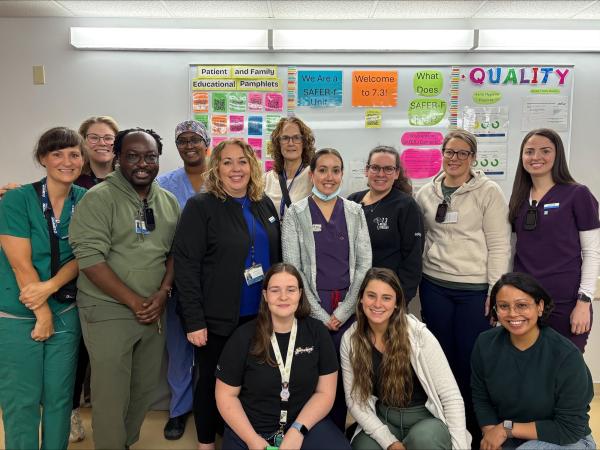
Photo of the neurosurgery and spine surgery team.