5 min read
Posted
Wednesday, November 12, 2025
at 6:45 PM AST
Posted by
Categories
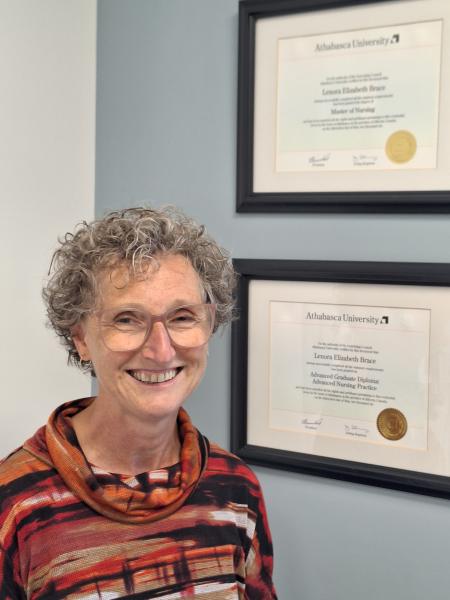
For nearly 40 years, Lenora Brace has been caring for patients, first as a licensed practical nurse, then a registered nurse and for the past 20 years, as a nurse practitioner.
Her career has evolved alongside the changing landscape of primary healthcare in Nova Scotia, where nurse practitioners now play a vital role in providing ongoing, comprehensive care, often serving as the most responsible provider for their own roster of patients.
“It’s invaluable having your own panel of patients, getting to know them and their health needs, and developing a therapeutic relationship over time,” says Lenora. “They trust your decisions.”
Lenora works in primary healthcare, providing primary care to her patients. She has patients from childhood, adulthood and older adults, supported by a multidisciplinary team that includes a nurse, a pharmacist and a social worker.
“Multidisciplinary care is important,” she says. “There are many patient needs registered nurses can address independently, and patients are booked with them appropriately. Collaboration adds tremendous value to patient care.”
When Lenora first became a nurse practitioner, the role looked very different. Early on, nurse practitioners were legislated to have a collaborating physician, and patients could book with either provider, which sometimes created confusion about responsibilities.
“Now, nurse practitioners in Nova Scotia can have their own panel of patients, and that has been an important step,” says Lenora. “It brings clarity to the role and helps patients understand the nurse practitioner profession.”
The nurse practitioner role is often compared to that of a family physician, though it’s rooted in a nursing foundation.
“In primary healthcare, I do very similar work to what a family physician does; I’m not a physician,” says Lenora. “Physicians come from a medical background; nurse practitioners come from nursing, with master's level education. Both professions are supported by legislation, and both are essential in providing timely, quality care.”
She believes that the growing recognition of nurse practitioners has been one of the biggest shifts over the past two decades. “I remember someone saying in my first year, ‘I’d never see a nurse practitioner.’ Two years later, they said they were beyond happy seeing a nurse practitioner,” she says. “It’s not about one versus the other. Both professions are extremely valuable.”
Lenora says much of the progress she’s seen has been made possible by support from Nova Scotia Health and the Department of Health and Wellness. “Everything that has happened has been positive,” she says. “The acceptance and support have been strong, and that’s essential for our continued growth.”
Throughout her career, Lenora has been an advocate for the profession. She has served as president of the National Nurse Practitioner Association, volunteered internationally as a nurse, and continues to mentor nurse practitioner students. “Seasoned and new nurse practitioners are happy to be a resource to colleagues,” she says.
For new nurse practitioners entering the field, Lenora offers this advice: “Give yourself time to develop confidence. The learning curve is steep in those first few years,” she says. “It’s important to grow into the role gradually. You can’t be assigned a large patient panel as a novice nurse practitioner and expect to know everything; it takes time and often mentorship.”
Another message Lenora has for her fellow nurse practitioners: “I want to let others know that I still have my Authorized Practices Schedule of Drugs and Drug Interventions for Primary Healthcare Nurse Practitioners, dated Nov. 2, 2007,” she laughs. “I started my job in Nova Scotia as a nurse practitioner on Nov. 5, 2007. It’s a piece of history in the early development years of nurse practitioners in Nova Scotia.”
Looking ahead, she hopes nurse practitioners continue to feel proud of their work while maintaining balance and self-care. “We can’t care for others if we’re not well ourselves,” she says. “Self-nourishment is essential; you have to have something to give.”
After 40 years in healthcare, Lenora still finds joy in the connections she builds and the progress she sees in her patients. “It’s rewarding when patients return and you see the change. It means everything to see patients reach their goals,” she says.
Nurse practitioners work in a variety of settings across the province: as part of collaborative primary healthcare teams, in emergency departments, mental health and addictions, chronic disease and wellness, perioperative (surgical) services, long-term care, and many other clinical settings. Our nurse practitioners provide preceptorship opportunities for students, as well as hold management roles, informing quality improvement and clinical practice.
Interested in advancing your career as a nurse practitioner with Nova Scotia Health? Visit our website: click here.
Photo of Lenora Brace.