7 min read
Posted
Friday, March 13, 2026
at 12:48 PM ADT
Posted by
Notice: Inpatient bedside phones are being phased out at Nova Scotia Health facilities beginning May 31. Please bring a personal device and charging equipment for your hospital stay.
Dr. Gabrielle Richard s’est tournée vers la pharmacie pour le lien entre la science et les soins aux patients. Deux décennies plus tard, elle est toujours animée par la même motivation.
« Les pharmaciens jouent un rôle unique en traduisant des informations médicales complexes en décisions concrètes qui améliorent la santé des gens », dit-elle.
« J’ai toujours été intéressée par la façon dont les médicaments peuvent modifier de manière importante l’évolution d’une maladie lorsqu’ils sont utilisés adéquatement, ainsi que par la prévention de leur utilisation inappropriée. La profession me permet d’appliquer des connaissances scientifiques tout en maintenant des liens significatifs avec les patients — ce que j’adore — et de contribuer directement à leurs soins. »
Richard, qui a grandi dans le petit village acadien de Petit-de-Grat, au Cap-Breton, est pharmacienne clinique depuis 20 ans. Elle a commencé sa carrière à Ottawa avant de revenir dans sa province natale pour se joindre à Santé Nouvelle-Écosse en 2010.
Elle a travaillé pendant un certain temps au Centre de santé Colchester East Hants à Truro et travaille maintenant à l’Hôpital Strait Richmond, au Cap-Breton.
Elle explique que travailler dans le système public plutôt qu’en pharmacie communautaire lui convient.
« Travailler dans le secteur public me permet de faire partie d’une équipe multidisciplinaire où nous collaborons pour résoudre des problèmes cliniques complexes », ajoute Richard.
« J’ai eu la chance de travailler avec des médecins, infirmières, physiothérapeutes, ergothérapeutes, diététistes, travailleurs sociaux, et techniciens extraordinaires, et j’ai actuellement une équipe phénoménale ici », à l’Hôpital Strait Richmond.
« J’aime aussi le fait que c’est un environnement où l’apprentissage ne s’arrête jamais — chaque cas de patient apporte quelque chose de nouveau, et être entourée de collègues de différentes disciplines élargit constamment mes connaissances et ma perspective. »
Elle met également à profit ses racines acadiennes et ses compétences en français lorsqu’il peut y avoir une barrière linguistique ou culturelle.
Ces interactions aident souvent à mettre les gens à l’aise, surtout parce qu’il existe des différences de sens et de contexte dans certains mots français et acadiens, explique-t-elle.
« Avoir quelqu’un qui comprend ce qu’ils disent de la manière dont ils le disent est très important. Je trouve que cela rend les interactions beaucoup plus fluides; j’ai l’impression que les gens se sentent davantage entendus et compris, et cela aide à réduire leur anxiété. »
C’est ce lien avec les patients qui l’inspire et la motive à continuer d’exercer la pharmacie pendant encore de nombreuses années.
« Les médicaments peuvent souvent être des sources de confusion ou de bouleversement, et j’aime pouvoir expliquer les choses clairement, répondre aux questions et aider les patients à se sentir plus à l’aise avec leur traitement », dit-elle.
« J’aime aussi contribuer à l’amélioration globale de l’état des patients et aider mon équipe multidisciplinaire à comprendre certaines des nuances de la pharmacothérapie. C’est extrêmement gratifiant lorsqu’un patient repart en se sentant plus confiant, rassuré ou physiquement mieux grâce à quelque chose à quoi j’ai pu contribuer. »
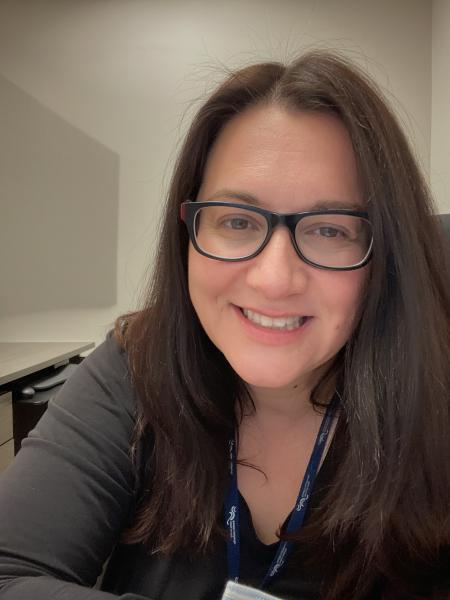
Photo de Dr. Gabrielle Richard.
English translation
Pharmacist Dr. Gabrielle Richard marks 20 years in patient care
Dr. Gabrielle Richard stepped into the pharmacy for its blend of science and patient care. Two decades later, she’s still propelled by the same purpose.
“Pharmacists play a unique role in translating complex medical information into practical decisions that improve people’s health,” she says.
“I’ve always been interested in how medications can significantly change the course of illness when used appropriately and in preventing them from being used inappropriately. The profession allows me to apply scientific knowledge while still maintaining meaningful connections with patients — which I love — and contributing directly to their care.”
Richard, who grew up in the small Acadian village of Petit-de-Grat in Cape Breton, has been a clinical pharmacist for 20 years. She started in Ottawa before moving back to her home province to join Nova Scotia Health in 2010.
She spent time working at Colchester East Hants Health Centre in Truro and now currently works at the Strait Richmond Hospital in Cape Breton.
Working in the public system rather than in community practice is something that suits her, she says.
“Working in the public sector allows me to be part of a multidisciplinary team where we work together to solve complex clinical problems,” Richard adds.
“I have been fortunate to have worked with some amazing physicians, nurses, physical therapists, occupational therapists, dieticians, social workers, and technicians and currently have a phenomenal team here” at the Strait Richmond Hospital.
“I also love that it’s an environment where learning never stops — every patient case brings something new and being surrounded by colleagues from different disciplines continually expands my knowledge and perspective.”
She also puts her Acadian roots and French-language skills to use whenever there may be a linguistic or cultural barrier.
Those interactions often help put people at ease, particularly since there are differences in meaning and context in some French and Acadian words, she says.
“Having someone who understands what they’re saying in the way they’re saying it is very important. I find it makes the interactions a lot smoother, I feel like people feel heard and understood more and it helps alleviate their anxiety.”
It’s that connection with patients that inspires and motivates her to continue working as a pharmacist for years to come.
“Medications can often be confusing or overwhelming, and I enjoy being able to explain things clearly, answer questions and help patients feel more comfortable with their treatment,” she says.
“I also enjoy contributing to the overall improvement of patients and helping my multidisciplinary team understand some of the nuances of medication therapy. It’s incredibly rewarding when a patient leaves feeling more confident, reassured, or physically better because of something I was able to help with.”
Photo of Dr. Gabrielle Richard.