6 min read
Posted
Sunday, May 24, 2026
at 12:00 PM ADT
Posted by
Categories
For people who are unhoused or precariously housed, accessing healthcare can come with barriers that sometimes feel impossible to overcome. A new partnership in Pictou County is working to change that.
Through a collaboration between Nova Scotia Health, the Pictou County Community Health Centre (CHC), the Department of Opportunities and Social Development (OSD), the Department of Health and Wellness (DHW), and Viola’s Place Society, teams are bringing primary care and wellness services directly to those in need.
“This is really about removing barriers,” said Susan MacConnell, executive director of the Pictou County Community Health Centre, a community-led organization focused on providing person-centred, prevention-focused primary healthcare. “For many of the people we’re working with, getting to a clinic, booking appointments, or following up on care just isn’t realistic right now.”
The clinic is set up on site every second Thursday at Viola’s Place, an emergency homeless shelter that offers 20 beds along with basic supports for people experiencing homelessness. By bringing healthcare providers together in one place, at the same time, the team is creating a single access point for care in a setting that is already familiar and trusted.
While the location supports those staying at or connected to the shelter, the clinic is open to the public as well.
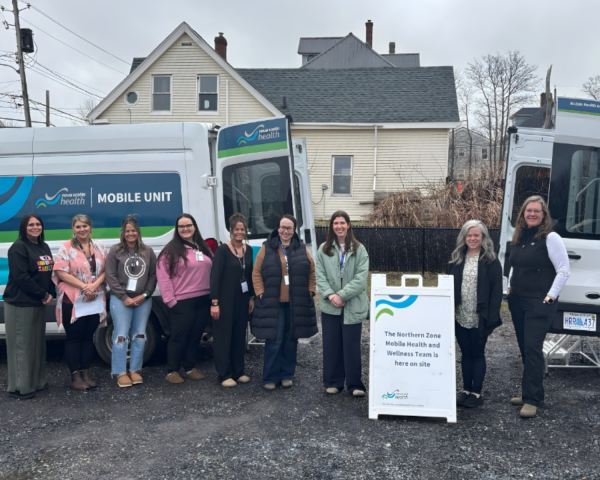
Services adapt based on identified needs. At the April 16 clinic, the CHC team helped people get or reactivate expired health cards, a first step in accessing care. The Northern Zone Mobile Health and Wellness Team (NZMHWT) had two mobile units on site, offering nursing care and Virtual Urgent Care appointments. A social worker was also present to provide counselling services and connect people to appropriate resources.
Laboratory technicians from Aberdeen Hospital were on site to collect blood samples, allowing any lab work ordered during the visit to be completed immediately instead of requiring a separate appointment.
Public Health was there to offer vaccinations and provide health education. And same-day physician or nurse practitioner appointments were arranged for anyone needing care. Transportation to the New Glasgow Primary Care Clinic was provided by the CHC team. For complex wound care, Ambulatory Care provided follow-up appointments.
The Mental Health and Addictions Program (MHAP) also provides addictions medicine outreach services at Viola’s Place during clinic days every second Thursday, helping connect people with additional supports.
“Health care can fall by the wayside when people are focused on meeting their basic needs. We’re really trying to build a model that wraps services around the person,” said Chelsea Atwin, health services manager for the NZMHWT.
Lisa DeYoung, executive director for Viola’s Place Society, said this model has been her goal for years. “Needs have changed a lot faster than our societal systems have been able to respond. Our staff may speak with someone and see they need care, but they might not be ready or capable of investing in their care yet. Bringing these services here to meet them where they are, we see them more willing to engage and more comfortable receiving the care they need. It’s a dream come true, really.”
While the clinics at Viola’s Place are new, the work is not. The NZMHWT was established as part of Nova Scotia Health’s ongoing efforts to reach underserved populations, with a mandate that includes vulnerable populations such as those experiencing homelessness or housing insecurity.
“This is really part of our day-to-day work,” said Helen Scott-Davidson, director of primary healthcare in Northern Zone. “What’s unique here is the level of collaboration, including across multiple branches of government.”
That collaboration grew out of existing relationships between organizations, with leaders like MacConnell helping to connect partners across sectors who already had boots on the ground.
“It’s not something where you can just show up and expect people to engage,” said Scott-Davidson. “It takes time, trust, and the right people already embedded in those spaces to make those connections.”
As the work continues, the focus remains on strengthening partnerships and learning from the community. There is interest in expanding the model to other communities, but for now, the priority is building something sustainable.
Early results are promising. In just the first two clinics, the team was able to connect with a significant portion of the local unhoused population, many of whom would not have accessed care otherwise.
For MacConnell and partners across the collaboration, the hope is that by addressing health concerns earlier, they’ll see reduced reliance on emergency departments and improved overall well-being, which may also support better housing and social outcomes over time.
“When people know there’s a consistent place they can go to access care, it builds trust,” said MacConnell. “And that’s where real change starts.”
To view upcoming Northern Zone Mobile Health and Wellness Team clinic locations and schedules, visit: www.nshealth.ca/NZMHWT
Photo of (L-R) Kenda Hayman, housing support worker, Viola’s Place; Lisa Deyoung, executive director, Viola’s Place; Maggie Ross, program manager, Viola’s Place; Mary Saunders, emotional wellness navigator, Nova Scotia Health; Mallory Kirkendall, housing support worker, Viola’s Place; Cassandra O’Donnell, laboratory assistant, Nova Scotia Health; Chelsea Atwin, health services manager, Nova Scotia Health; Kasey Steele, administrative assistant, Nova Scotia Health; Holly Hilton, registered nurse, Nova Scotia Health.