4 min read
Posted
Friday, July 31, 2026
at 12:00 PM ADT
Posted by
Categories
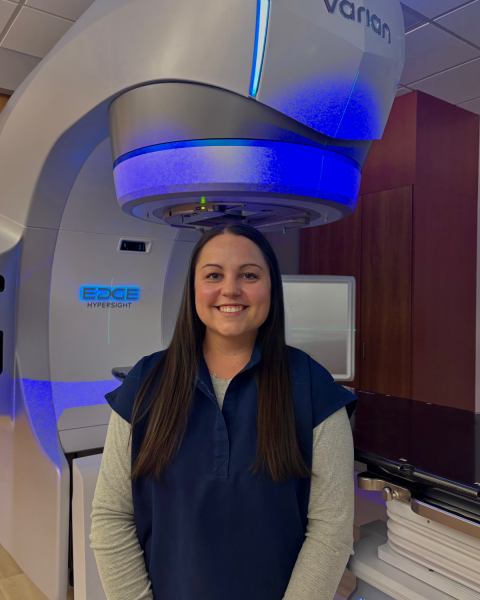
Carissa Shank learned about the field of radiation therapy somewhat by chance. Originally from Ontario, she was in her final year of an undergraduate kinesiology degree when students were asked to complete a research project on a topic of their choice.
“I chose cancer treatments and modalities and that’s when I learned about the role of a radiation therapist,” Carissa says. “After a little more research, I believed it would be good fit for me and I registered for the program at the Michener Institute in Toronto. I completed my studies in 2021 and accepted a clinical placement at the QEII Cancer Centre in Halifax – to have the opportunity to see and enjoy the East Coast. I am so happy I did. I was offered a job at the end of my placement and have been here ever since.”
Carissa’s workdays are busy and varied. “I work with wonderful people,” she says. “I love being part of a team of many different health professionals – all working together to ensure patients are supported throughout their journey and receive the best care. On any given day, I may consult with my radiation therapy colleagues, dosimetrists, physicists, doctors, nurses, dieticians, speech pathologists and others – depending on what my patients need.”
Radiation therapists deliver radiation treatments to patients with cancer and other diseases.
Carissa’s workday begins with quality checks to ensure the machines are working properly, then a review of the patient’s chart prior to each appointment to ensure all the information needed is in hand.
She and other radiation therapists may be working with patients who are scheduled for a CT simulator (sim) appointment or for radiation treatment. Both processes follow similar steps.
The CT sim appointment is the first step following development of the treatment plan. It could be described as a practice run prior to treatment. The CT sim occurs just before the start of a patient’s treatment and mocks up their daily treatment set-up. This includes an updated CT scan to compare with the earlier scan to see if anything has changed. The radiation treatment plan is developed using this scan. Tattoos or markings are done at this time as well – to guide positioning of the patient and precise targeting of the radiation beam on the tumour while sparing health tissue.
Following the CT sim, the patient is scheduled for treatment. At the beginning of the patient’s appointment, whether for a CT sim or treatment, the radiation therapist talks with the patient, assessing their health with questions about how they are feeling, whether they are in pain, or if there are any issues since the last appointment. Based on patient responses, the radiation therapist may consult with other health professionals to determine if changes to the treatment plan are needed.
“Radiation therapists are a constant for patients,” says Carissa. “With patients needing anywhere from 1-40 treatments, we see most patients daily for a number of weeks. We get to know and build a rapport with them, earn their trust and help them through their cancer journey.”
Carrissa says she often hears from patients at the end of their treatment that it has been a very positive experience, despite also being a time of worry and stress.
“Although it’s a happy occasion when patients finish their treatment, it can also be emotional for us and for them. That’s when we remind them that we look forward to meeting them in the grocery store instead of the cancer centre,” she says.
“I love this job and I love working at Nova Scotia Health. It is a real privilege to be able to study in a field that enables me to help so many people in such a meaningful way.”
Learn more about radiation therapy with Nova Scotia Health and discover incredible career opportunities in Halifax and Cape Breton.
Photo of Carissa Shank.