4 min read
Posted
Monday, September 14, 2026
at 9:00 AM ADT
Posted by
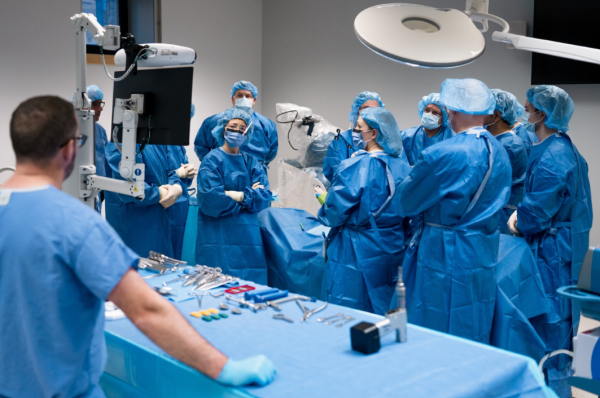
Before a patient enters the operating room, many healthcare providers have practiced skills and scenarios to help them prepare for the many expected and more unusual situations that can arise during surgery.
Across Nova Scotia Health, simulation serves as a safe and highly realistic learning environment where learners, nurses, residents and other clinicians can refine their skills, strengthen clinical decision-making, and rehearse complex surgical situations before applying those skills in real patient care settings.
For surgical services, simulation supports surgical team members as they prepare for everything from routine procedures to more complex cases and rare emergencies in the operating room.
"We provide a safe place for residents to practice the skills they need to do surgery," says Allison Lenihan, Skills Centre coordinator and perioperative (surgical services) educator for the QEII Simulation Program. "We do our best to set the lab up to mimic an operating room setting."
Through simulation labs, surgical skills centres and cadaveric training (training on human bodies donated for medical learning), healthcare teams can practice in environments designed to mirror the realities of the operating room.
The QEII Simulation Program’s Sim Bay, a healthcare training facility was made possible through a $1.8 million investment from QEII Foundation donors. The Sim Bay opened in 2018, and at the time was one of North America leading medical simulation training facilities and the only hospital-based simulation facility in Canada to offer clinical-grade cadaver procedure learning on-site.
The Skills Centre is also home to the Stryker Mako SmartRoboticsTM System orthopedic training robot, also proudly supported by QEII Foundation donors, which allows surgeons to access advanced robotic surgery training closer to home and build expertise in hip and knee replacement.
Simulation training allows teams to practice procedures repeatedly, refine technical skills, and strengthen communication and collaboration between team members. Beyond individual learning, surgical teams also complete full scenarios in realistic clinical environments to help identify barriers, improve workflow, and enhance patient safety.
Healthcare teams can access simulation-based learning in various ways. Alongside simulation labs across the province and a cadaveric lab, the Nova Scotia Health Learning Institute for Healthcare Providers holds courses to support advanced training for perioperative nurses and anesthesia technicians, as well as courses for surgical team members to train as simulation facilitators and educators.
"These courses and simulation learning are aimed at improving care and health outcomes and enhancing patient experiences," says Lisa Froese, nurse educator at the Learning Institute. "Simulation protects the patient while we're learning. For learners preparing to enter the operating room, simulation offers valuable hands-on experiences before they care for patients."
September 14 to 18 marks Healthcare Simulation Week – a time to recognize the vital role of simulation in supporting healthcare teams, improving preparedness, advancing care across the province, and delivering safe, high-quality care for Nova Scotians.
Photo credit QEII Foundation.