3 min read
Posted
Tuesday, September 22, 2026
at 9:14 AM ADT
Posted by
Categories
Imagine leaving Yarmouth before sunrise for a 9 a.m. CT scan in Halifax. After the scan, you wait for it to be reviewed and for a radiation treatment plan to be developed before finally receiving treatment and beginning the three-hour drive home, arriving back in the evening. It would be an exhausting day for anyone, especially someone who is unwell.
The Department of Radiation Oncology's multidisciplinary direct-to-unit treatment team is working to change that experience for certain patients who require a single radiation therapy treatment for pain and symptom management.
On August 7, 2026, following months of planning, the first Nova Scotian received direct-to-unit treatment at the QEII Cancer Centre in Halifax using the Ethos treatment unit, marking an important milestone for the Department of Radiation Oncology.
"We are so pleased to finally have this option for patients who qualify for direct-to-unit treatment," says Dr. Hannah Dahn, radiation oncologist and physician lead for the Direct-to-Unit Treatment Care Team. "This approach eliminates the need for a separate CT simulation appointment and reduces the overall time patients spend at the cancer centre. While it requires a radiation oncologist and a physicist to be present during treatment, the benefits are significant. Patients who are uncomfortable can receive treatment and be back home within a couple of hours, rather than spending an entire day travelling and waiting for care."
Direct-to-unit treatment, also known as simulation-free radiation therapy, is a form of adaptive radiation therapy that allows the treatment plan to be adjusted to accommodate changes in a patient's anatomy. Instead of creating a treatment plan from a separate CT simulation scan, the team uses the patient's diagnostic imaging as the foundation for planning and completes an additional scan on the treatment unit immediately before treatment.
Currently, one patient per week receives direct-to-unit treatment. As workflows and protocols continue to be refined, the goal is to expand the program to be able to treat up to one to two patients each day.
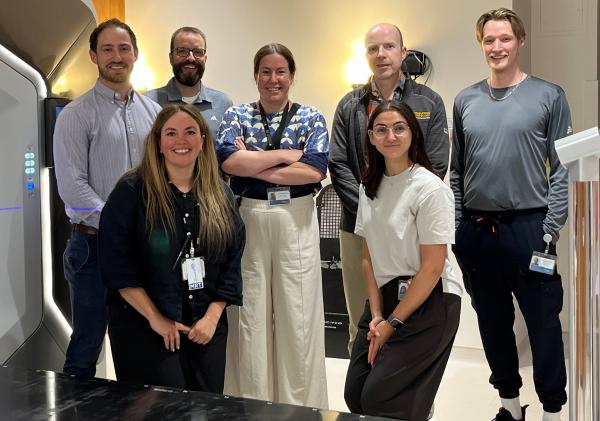
Photo:
L to R: (back row) Lee Macdonald, Dal Granville, Hannah Dahn, Derek Wilke, Ethan Perkins
L to R: (front row) Jennifer DeGiobbi, Andi Saade