6 min read
Posted
Friday, June 19, 2026
at 3:38 PM ADT
Posted by
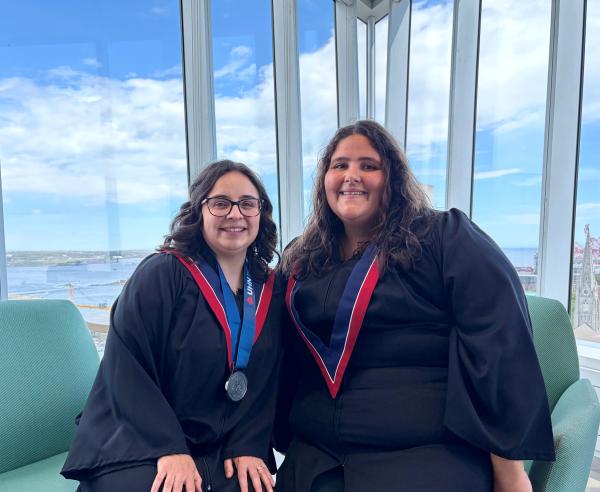
Co-valedictorians’ Robyn Samson-Anthony and Sarah deMolitor are leading a graduating class of 17 medical laboratory technologist (MLT) into new careers at Nova Scotia Health laboratories across the province.
“In many ways, we are the first to see a patient’s story unfold through their laboratory results,” Sarah says. “It’s a responsibility and a privilege—and it’s why this work matters.”
Speaking to their graduating class at their spring convocation, the duo marked the culmination of a unique partnership between Nova Scotia Health and the Michener Institute of Education at the University Health Network.
Part of Nova Scotia’s Action for Health plan, the initiative was designed to address an urgent need for these skilled technologists. More training seats were also added to the Nova Scotia Community College (NSCC) MLT program, further increasing the opportunities for those interested in joining the province’s laboratory workforce.
The graduates’ journeys into Nova Scotia laboratories followed different paths but converged through a program built on flexibility, opportunity, and practice readiness.
The three-year program combined online coursework delivered by Michener with hands-on laboratory and clinical placements across Nova Scotia Health facilities. This blended approach allowed students to complete their training without having to leave the province, ensuring they were job-ready from day one.
As valedictorians, Robyn and Sarah spoke not only to personal achievement, but to the lasting impact of an innovative program that strengthens the team of nearly 600 MLTs across the province.
Medical laboratory technologists serve a critical, often unseen role in healthcare. They analyze blood, tissue, and other samples to help detect, diagnose, and monitor disease, producing results that inform many medical decisions. From emergency care to routine testing, their work is essential to timely diagnoses, effective treatments and better patient outcomes.
Nova Scotia Health is already seeing progress, with the vacancy rate for MLTs decreasing over the past year as efforts continue to train, recruit and retain workers in these essential roles. The number of full-time equivalent (FTE) MLTs working with Nova Scotia Health has grown by approximately 10 per cent over the past four years (March 30, 2026 vs March 30, 2022).
Robyn now works as a medical laboratory technologist at Colchester East Hants Health Centre’s core laboratory in Truro, which includes chemistry, transfusion medicine and hematology.
Previously, she worked in another laboratory related role, and as an educational assistant. She saw the MLT program as a pathway back to the laboratory that supported a better work-life balance.
“The idea of a hybrid program that allowed me to study at home while caring for my family made it possible to return to the lab and rebuild my career.”
Through the program, Robyn worked alongside classmates both virtually and in person, which sharpened the skills needed in a collaborative healthcare environment.
“Learning to collaborate really prepared me for the teamwork and communication that are so critical in the lab,” says Robyn. “MLTs are behind some of the most important tests healthcare providers rely on—our work helps guide decisions in both emergency and routine care.”
For Sarah, the journey began on the front lines of patient care as a medical laboratory assistant, and this partnership became an opportunity to build on her career.
As a mature student living in a rural community, the program’s accessibility was key.
“The program allowed me to continue living and working in my community while pursuing this dream,” she says. “That accessibility opened doors for students like me who might not have had the opportunity to advance their education and careers.”
Now working in the core laboratory at Yarmouth Regional Hospital, Sarah credits the program’s design for a smooth transition into practice.
“There was a real sense of familiarity stepping into practice—from the systems we used to the workflows we learned, it gave me confidence right from day one.”
Together, Robyn and Sarah’s stories highlight what made the partnership so effective – it met learners where they are, supported them through training, and equipped them to contribute immediately in a high-demand role.
They closed their valedictorian address saying:
"Behind every specimen is a patient waiting for answers. Behind every result is a healthcare team relying on our accuracy, knowledge, and care. What we do matters, even if most people never see it happening."
To learn more about Medical Laboratory Technologists:
Photo left to right: Valedictorians Robin Samson-Anthony (Michener silver medal recipient) and Sarah deMolitor