6 min read
Posted
Wednesday, July 22, 2026
at 12:00 PM ADT
Posted by
Categories
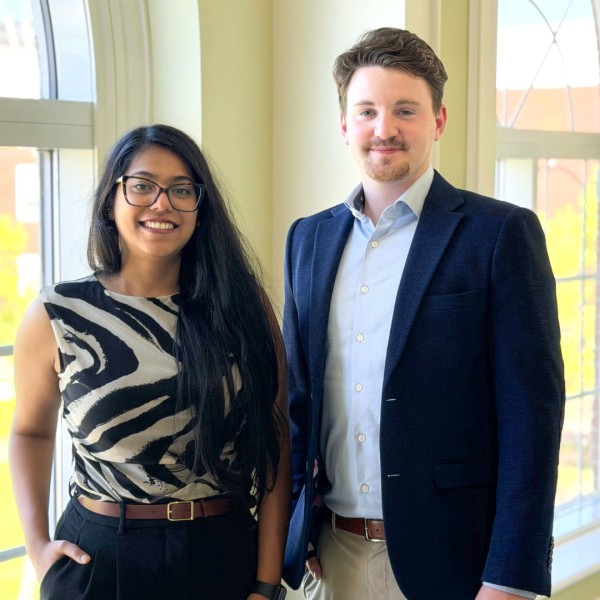
The Nova Scotia Health Performance and Analytics team has an international flavour helping design cutting-edge artificial intelligence programs to address workforce and patient-flow challenges.
Conor Newcombe and Navya Jayapal arrived in Nova Scotia from the U.K. and India respectively and now play an integral role with the Performance and Analytics team.
Newcombe serves as analytics lead for artificial intelligence and machine learning operations, where he and his team of developers, analysts and data scientists build capacity to aid healthcare leaders better understand workforce and patient-flow challenges and potential improvements.
Jayapal is on Newcombe’s team and is working on major projects like the Nurse Forecasting and Matching Tool, known as NFMT, and the Flow Forecasting and Strategizing Tool, or FFAST.
Both systems are designed to help staff make more informed data decisions, while keeping people at the centre of the process.
“Not to automate [roles], but to elevate,” Jayapal said of the overall objective.
Jayapal came to Nova Scotia to complete a master’s degree in Applied Computer Science and joined Nova Scotia Health as an intern. Four years later, she remains with the organization because of the opportunity to apply emerging technologies to real-world challenges.
“The work we do is honestly what made me stay,” she said. “We actually get a chance to directly impact the users.”
Meanwhile, Newcombe studied Digital Innovation and Health Informatics at Dalhousie University before joining Nova Scotia Health about four years ago. He also puts high value on the work and opportunities within the organization.
“It’s still highly stimulating,” he said. “There’s always a new problem to solve.”
The NFMT helps health-service managers anticipate staffing needs up to a year in advance. Drawing on historical organizational data, the system forecasts factors such as arrivals, departures, transfers and leaves, giving leaders a broader view of potential vacancies before they occur.
The tool also assists recruiters by recommending potential candidates for open positions. Human decision-makers remain responsible for hiring, but the technology helps flag important information more quickly and efficiently.
Jayapal said the goal is to support existing processes rather than replace them.
When it comes to the tasks of recruiters and managers, “we try to make their work easier,” she explained.
The FFAST platform takes a similar approach to patient-flow management. Before its development, key performance indicators were often spread across multiple dashboards and updated on varying schedules.
Newcombe said the team’s goal was to create a centralized system that would provide timely access to information while also offering short-term forecasts.
The platform now brings together indicators from across the health system and uses machine learning models to predict trends up to a week into the future. Leaders can use the information to support planning decisions related to staffing, patient volumes and resource allocation.
One of the system’s strengths, Newcombe pointed out, is its ability to show how different parts of the health system influence one another.
Emergency departments, inpatient units and continuing-care services are often viewed separately, but patient flow depends on all three working together. By visualizing those connections, the platform helps users better understand pressures across the broader system.
Jayapal and Newcombe both stressed building those tools requires significant work behind the scenes.
Data from multiple source systems must first be brought together through secure digital pipelines before being vetted and prepared for analysis. The work is supported by cloud infrastructure and cybersecurity services provided through the Nova Scotia’s digital services teams, allowing Nova Scotia Health’s analytics staff to develop and maintain solutions internally.
That in-house model makes for major advantages for analytics personnel like Jayapal and Newcombe. Since the team controls the development process, they can rapidly test ideas, incorporate user feedback and adapt products as needs evolve. New features are often delivered in small increments, allowing frontline users to help shape the final result.
“We strictly follow the agile approach,” Jayapal said. “The users are very much part of the building process.”
The team’s work has also attracted attention from peers across Canada. Conference attendees are often surprised to learn how much advanced analytics and machine learning development is being carried out independently within Nova Scotia Health.
Yet both emphasize the technology itself is only part of the story.
Jayapal and Newcombe believe the real strength behind the technology is the tireless efforts of colleagues who are committed to continuous learning, innovation and improvement.
“These projects never really end,” Newcombe said. “There’s always monitoring and maintenance involved.”
“Technology keeps changing,” Jayapal added. “We keep improving and we keep building.”
Photo of Navya Jayapal and Conor Newcombe.