6 min read
Posted
Wednesday, February 11, 2026
at 12:00 PM AST
Posted by
Categories
For many people, a heart attack or other cardiac diagnosis doesn’t end when they leave the hospital. Physical recovery is only one part of what comes next. Many people are left navigating fear and major changes to their daily lives. That’s where the REDUCE-IT cardiac rehabilitation program comes in.
Delivered through Nova Scotia Health, REDUCE-IT is a 12-week cardiac rehab program for people who have experienced a heart attack, heart surgery, or another cardiovascular condition. Unlike earlier rehab models, the program allows medication adjustments to happen during rehabilitation, alongside supervised exercise and education, to help lower the risk of future cardiac events.
“At its core, cardiac rehab is about secondary prevention,” said Dr. Brian Moses, General Internist and Department Head for Internal Medicine and lead for the Cardiac Rehab Program in Western Zone. “People have already had a cardiac event, and we’re trying to prevent another one from happening. We know exercise and education reduce risk, but we also know that medication adjustments reduce risk. The REDUCE-IT model combines those pieces into one program.”
“As you move further from Halifax, populations tend to be older. Age is one of the biggest risk factors for vascular disease, so rural zones see higher rates. Programs like REDUCE-IT matter because they bring structured support closer to where people live.”
REDUCE-IT programs operate at several sites across the province and are delivered by multidisciplinary teams including registered nurses, dietitians, physiotherapists, nurse practitioners and/or pharmacy support. Each professional contributes their expertise, allowing care to be shaped around what participants need at different points in their journey.
Opening a Door to Wellness
“We aim to meet people where they are,” said Lisa Cook, a registered nurse with New Glasgow’s One Door Chronic Disease Management Centre – a cardiac rehab and REDUCE-IT site. “If someone is nervous about movement, we support them through that. If questions come up around food, our dietitian can help. If stress or fear is getting in the way, our social worker is there to work through it.”
Before starting REDUCE-IT at One Door, participant assessments are reviewed by Dr. Rayan Alhazmi to confirm they are ready for the program or if additional follow up is needed. Once enrolled, participants attend supervised exercise sessions twice a week at the Orthopedic Assessment Centre in New Glasgow, using equipment such as treadmills and stationary bikes. Every second week, they also take part in education sessions that focus on practical topics like exercising safely, understanding medications, managing stress, and making heart-healthy choices at home.
An important part of the One Door program is goal-directed medication therapy. Nurse practitioners Pamela Palmer and Kelly Murray make necessary medication adjustments as participants move through the program, ensuring timely medication management is part of rehabilitation.
Susan LeBlond, the program’s dietitian, focuses on keeping nutrition advice realistic and achievable. “We talk about eating in a way that supports heart health, but it has to fit into real life. One popular feature is “Recipe Thursday,” where participants browse heart-healthy recipes or bring in familiar meals to adapt together. “People don’t want to feel like they’ve lost everything they enjoy,” Cook said.
While exercise is a visible part of the program, the emotional impact of a heart event is just as important. “A heart event isn’t only physical,” said social worker Jenine Bateman. “It can be frightening. It can change how people see themselves. Many participants arrive feeling ashamed or worried about doing the wrong thing.”
Bateman works with participants to normalize those reactions. “We talk about how common these feelings are and how understandable they can be. When people hear others share similar experiences, it helps reduce isolation.”
The group setting plays a powerful role. Over the course of 12 weeks, participants build trust with one another and often form strong connections. They notice when someone is absent and check in on each other. Many continue those relationships after the program ends.
“That peer support makes a huge difference,” Cook said. “People realize they’re not alone, and that helps rebuild confidence.”
By the end of the program, participants often show greater confidence in recognizing and responding to their bodies’ signals. “At the beginning, every ache can feel alarming,” Cook said. “By the end, people understand their bodies better. They know what’s normal, and they feel safer being active again.”
Dr. Moses hears similar feedback across the province. “Patients consistently tell us how much they value the program,” he said. “They enjoy the structure, the education, and the sense of support. It’s not just about what happens during the 12 weeks. It’s about setting people up for life after rehab.”
Learn more about the REDUCE-IT Cardiovascular Rehabilitation program.
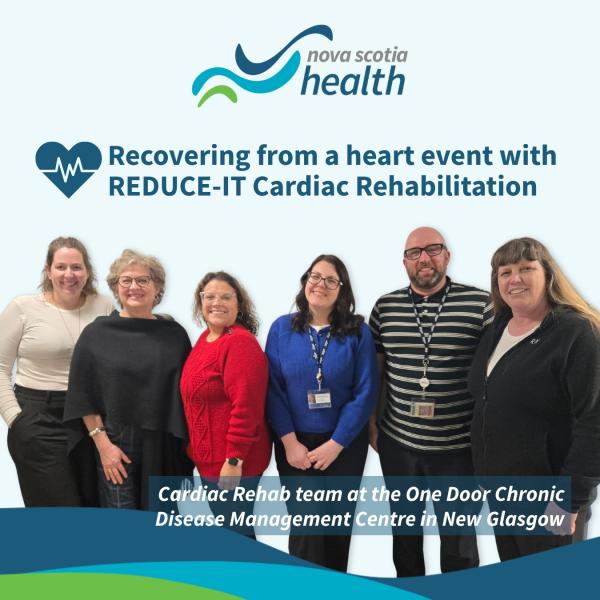
Photo of Cardiac Rehab Team at The One Door Chronic Disease Management Centre in New Glasgow. Left to right: Pamela Palmer, nurse practitioner; Susan LeBlond, registered dietitian; Leslie Bellefontaine, pharmacist; Jenine Bateman, social worker; Simon Robertson-Palmer, physiotherapist; Lisa Cook, registered nurse. Missing: Kelly Murray, nurse practitioner.