6 min read
Posted
Wednesday, January 28, 2026
at 4:03 PM AST
Posted by
It wasn’t until Woody Skanes began working with a clinical therapist at the Nova Scotia Operational Stress Injury (OSI) Clinic that he fully understood the trauma he had been living with for so many years.
Skanes, who retired after more than 40 years with the Royal Canadian Dental Corps in the Canadian Armed Forces, first visited the OSI Clinic in Dartmouth in 2023 shortly after his wife of 54 years passed away.
After a few sessions, Skanes was diagnosed with post-traumatic stress disorder and suddenly the road ahead to recovery became clear.
“It’s funny that when you start to peel the onion and you start to put names to things and eventually it starts to make sense, it starts to fall in place,” he said. “It was a humbling experience, I’ll tell you that, and a very traumatic one.”
He decided to seek out help from the OSI Clinic, which recently celebrated its 10th anniversary in Nova Scotia, after he had difficulty coping with his symptoms following the loss of his wife.
“What was going on with me wasn’t spoken of for over 40 years and then my wife passed,” he said. “She was always the one who was there for me when things got rough and I needed help. She was the one who would put her arms around me and said everything’s going to be OK.”
With support from partners at Veterans Affairs Canada and Nova Scotia Health, the clinic employs an interdisciplinary team of professionals at sites in Dartmouth and Sydney and available virtually throughout Nova Scotia who are dedicated to working with people who have served in the military or the Royal Canadian Mounted Police (RCMP). The clinic provides evidence-based treatments to help people reach their goals.
Sarah Lefurgey had a similar experience after seeking help from the clinic.
After 11 years with the RCMP in British Columbia, Lefurgey returned to her roots in Nova Scotia in 2020 to start a new career. It was then that symptoms began to manifest in the form of nightmares and flashbacks.
She sought help and felt immediately comfortable at the OSI clinic, an environment where she felt seen and understood. It was that compassion and understanding that she credited with helping her in her recovery.
“The things we experience in the military and in policing are well understood here. They speak the language. They know it well. That meant I didn’t have to explain the role and the organizational environment and could instead, focus on the impact and my recovery,” she said after speaking at the OSI Clinic's 10th anniversary celebration in December.
After years of weekly therapy, Lefurgey is now putting her skills to use, working with Dr. Abraham (Rami) Rudnick, co-lead at the clinic, doing research, writing peer-reviewed articles, and lecturing on person-centred care and trauma disorders at Dalhousie University.
“I thought leaving policing was the end of being able to use the skills I developed in policing, but I soon learned they are very transferable,” Lefurgey she said.
“At the beginning I felt really stigmatized by the things I was experiencing, because they’re really impactful,” she added. “But I’ve definitely turned those experiences into a growth moment and I try to speak openly so that other people don’t feel the same stigma or shame. We all carry something. Courage is contagious, and sharing our stories reminds us that being human connects us more than it separates us.”
For his part, Skanes credits clinical therapist Jesse Lightstone with his turnaround.
“I still get really emotional, when I even think about what he was able to do for me. He’s given me my life back,” he said. “I’ll have this grief and this trauma for the rest of my life, I don’t have any illusions about being ‘cured’. What I do know is that I’ve been given the tools to help me manage and to live with things that have happened and to make sense of it all and to know that I am not alone in this journey.”
A social worker with years of experience in community mental health, Lightstone joined the OSI Clinic three years ago and immediately began immersing himself in learning about the culture and environment that service members live through.
“People who have been through complex experiences have complex symptoms and so they need adequate treatment to improve those symptoms,” said Lightstone. “And so, this is an office where when I came here, I saw that you need to bring your best here and quite frankly these clients deserve that.”
He said while he appreciates when he hears comments from clients like Skanes, they are the ones who really do the hard work and should be commended.
“It’s a reminder that good things happen, because there can be hard days in this job, too,” he said.
“There’s so much richness that comes from this job and I entered social work because I wanted to help people and that’s what I get to do here. It’s honestly changed my personal life in the way in which I relate to the world outside this office, because it’s quite often that I am emotionally and spiritually moved by the clients in the feedback they give and my colleagues, too.”
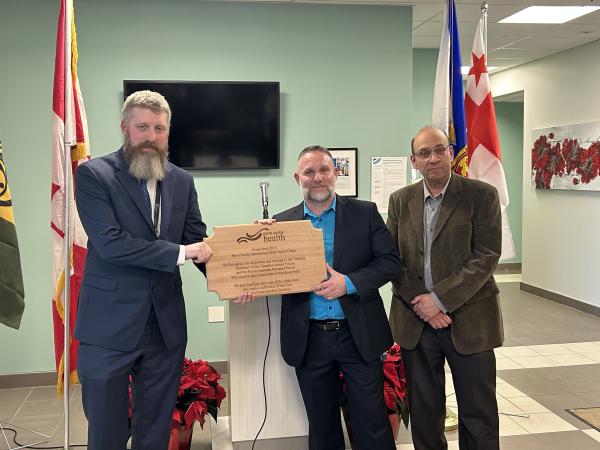
Photo of Matt White, Central Zone director for the Mental Health and Addictions Program, along with clinic co-leads Patrick Daigle and Dr. Abraham Rudnick at the tenth anniversary celebration of the Nova Scotia Operational Stress Injury Clinic.